This Fiat Siena with 1.4 FIRE engine runs on Hydrogen fuel
As a part of university research project in Brazil, a Fiat Siena ‘Tetrafuel’ 1.4 has been converted to burn hydrogen fuel, essentially retaining the engine block and other mechanicals.

Fiat Siena is perhaps a long gone nameplate that is unlikely to hit headlines, even in Brazil, but one car did recently. Researchers at the Federal University of Santa Maria (UFSM) has successfully converted a first-generation, Type 4 Fiat Siena ‘Tetrafuel’ (2007-2016) into a hydrogen car, something that nobody would have ever imagined even in their wildest dreams!
The sedan, equipped with 1.4-litre FIRE (Fully Integrated Robotized Engine) series engine, originally came as ‘Tetrafuel’ model (with factory-fitted flex-fuel system) that can run on Petrol, Ethanol (E25), and as bi-fuel with CNG. This architecture would have privileged the car as a natural fit for the H2 car project, although none of the stock CNG storage and fueling system was retained.
Related: Fiat Siena 1.2 FIRE: Mid-term overhaul of my 1999 ‘OG’ Fiat sedan!
The conversion, carried out by the the Research Group on Engines, Fuels and Emissions (GPMOT), associated with the Technology Center of UFSM, involved modifications to the fuel injection and intake systems. Hydrogen requires unique sealing, connection and fuel control strategies, unlike petrol or natural gas.
Minimal changes to mechanicals
The team employed a re-programmed ECU (Electronic Control Unit) to suit the injection and ignition timing of the hydrogen combustion. What is so remarkable is that the stock 1.4-litre, 8-valve (SMPI) FIRE engine block was retained, with no changes warranted for the geometry of the combustion chamber and ratios. The transmission and every other mechanicals of the sedan received no tweaks. The engine originally churned out 90 PS (60 kW) in petrol.
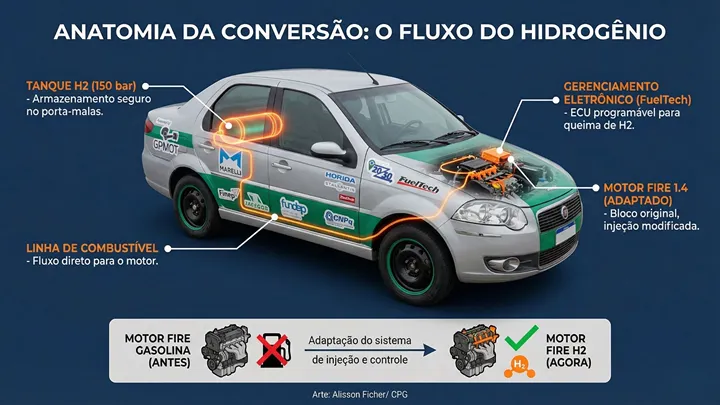
Further, the ‘new’ fuel is stored in a dedicated cylinder at a pressure of 150 bar, which is significantly lower than found in most of the hydrogen fuel cell vehicles in the market. The tank, presumably located in the trunk, consists of pressure regulator and solenoid valves to control H2 flow for maximum safety and efficiency. The researchers have also added additional instrumentation including sensors in intake and exhaust systems for data during the calibration phase.
Related: Toyota Corolla Cross Hydrogen ICE concept presents new possibilities
Considering the lower volumetric energy density of the fuel, as H2 is sent to intake manifold in low pressure, the researchers have observed a drop in original power. This is expected, as in case of every CNG or LPG conversions. Appropriate super-charging technology can offset this limitation, although that is not the core objective of this project.

As in case of every hydrogen combustion (ICE) engines, the project car emits only water vapour, and no CO2. However, H2 ICE technology is not exactly “zero-emission”, as the system does emit oxides of nitrogen (NOx) similar to that of conventional fuel vehicles.
Source: Click Petróleo e Gas (CPG) | Photos Credit: Alisson Ficher (CPG)