Airbus at Dubai Airshow 2025: Cleaner, connected vision for Middle East
The commercial momentum of Airbus aircrafts was clearly visible in a series of announcements tied to the Dubai Airshow 2025.
At the recently concluded Dubai Airshow, Airbus painted a clearer picture of where it sees aviation is heading. The company’s presence combined a strong commercial line‑up with visible commitments to sustainability and digital innovation, all backed by fresh orders from both new and existing customers in the Middle-Eastern region and beyond.
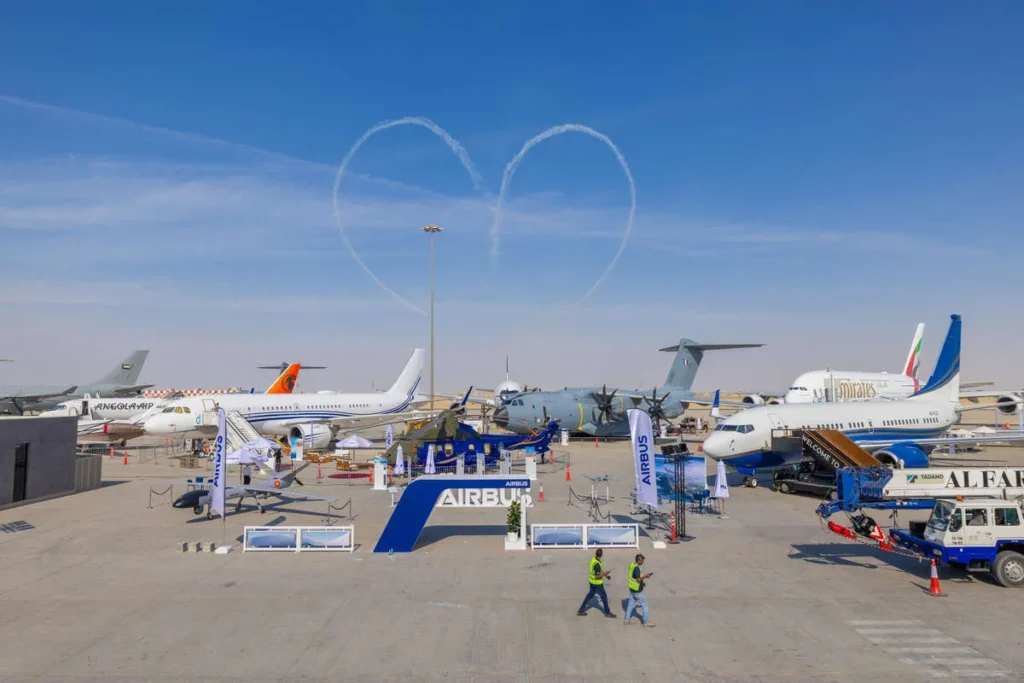
This year’s show carried the theme “The Future is Here”, and Airbus leaned into it by framing its entire participation around innovation, sustainability and collaborative growth with regional partners. The company positioned itself as a strategic player in the UAE’s broader plan to build a diversified, high‑tech, and net‑zero economy.
The Airbus pavilion at P10 became the hub of this narrative, supported by the main stand and a dedicated space stand, where visitors could explore interactive exhibits and immersive experiences across commercial aviation, helicopters, defence and space. Throughout the week, Airbus hosted customers, government delegations and industry professionals, turning the chalet and static display into a stage for both business and long‑term cooperation discussions.
Star aircraft on static and in flight
On the tarmac, Airbus brought a cross‑section of its latest‑generation fleet, with widebodies and single‑aisles side by side to underscore a “family” approach to fleet planning. Among the highlights were Airbus A350 and A380 aircrafts on static display, drawing steady crowds of visitors who wanted to see long‑haul efficiency and iconic double‑deck capacity up close.
Single‑aisle attention gravitated toward models like the A321LR and A321XLR, which showcased how airlines can open thinner long‑range routes with lower fuel burn. The Airbus A220‑300 illustrated how regional and short‑haul networks are being modernized. In daily flying displays, Airbus demonstrated performance, low‑noise characteristics and the kind of flexible mission profiles that operators increasingly demand.
Sustainability and future technologies
Sustainability was woven through almost everything Airbus did at Dubai, rather than treated as a separate talking point. The company emphasized a mix of “decarbonization levers” including fleet renewal, sustainable aviation fuel (SAF), Book‑and‑Claim mechanisms and carbon‑inset solutions, sending a clear message that there is no single silver bullet for greener flight.
Related: Emirates brings its 19.1-year-old Airbus A380 back to passenger service
In the UAE context, the company spotlighted work to support domestic SAF and hydrogen capabilities. This aligns with the country’s Net Zero 2050 strategy and its ambition to become a global hub for greener aviation capabilities.
Orders, commitments and key customers
The commercial momentum was clearly visible in a series of announcements tied to the show. Libyan carrier Buraq Air and flydubai became new Airbus customers with MoUs for 10 A320neo Family aircraft and150 A321neo aircrafts respectively. In the wide body space, Etihad signed up for 16 aircrafts including A330neo, A350-1000s and A350F, while Emirates ordered eight more A350-900 at the expo.
Moreover, Air Europa reached an MoU for up to 40 A350-900 aircraft. In the freighter space, Silk Way West Airlines signed for two additional A350F aircraft, reinforcing confidence in Airbus’s new‑generation widebody cargo platform. Airbus has also bagged some orders for its helicopters, including H225M and H160S models.
Taken together, Airbus’s presence at the Dubai Airshow came across as a carefully balanced mix of near‑term commercial wins and longer‑term bets on sustainability. The company was clearly laying down markers for how it intends to help shape the next decades of global aviation from the heart of the Middle East.
Related: Airbus ZEROe Hydrogen-powered aircraft project – Latest updates